
Search Engine Marketing (SEM) is a form of paid digital advertising where businesses bid to appear at the top of search engine results pages (SERPs) on platforms like Google and Bing. In India, SEM runs primarily through Google Ads on a Pay-Per-Click (PPC) model — you only pay when someone clicks your ad. The 7 core components of a successful SEM strategy are: (1) Keyword research targeting buyer-intent queries, (2) Campaign and ad group structure, (3) Compelling ad copy with strong CTAs, (4) Landing page optimisation for conversion, (5) Bidding strategy selection — manual or Smart Bidding, (6) Negative keyword management to eliminate wasted spend, (7) Continuous A/B testing and performance monitoring. SEM delivers immediate visibility, unlike SEO, which takes months to show results. India's low CPC rates make it one of the highest-ROI paid search markets in the world.
Introduction
India has over 750 million internet users, and Google commands more than 95% of the country's search market. Every day, hundreds of millions of searches are made for products, services, and solutions — and businesses that appear at the top of those results win the click, the lead, and the sale.
Search Engine Marketing (SEM) is how you get there immediately. Unlike SEO, which builds rankings over months, SEM puts your brand at the top of Google the moment your campaign goes live.
This guide covers everything you need to know about SEM in India in 2026 — from what it is and how it works, to campaign types, costs, and strategies that deliver measurable ROI.
Key Takeaways
- SEM is paid search advertising — you bid on keywords and pay per click (PPC).
- Google Ads dominates SEM in India with 95%+ search market share.
- SEM delivers immediate results; SEO takes 3–6 months minimum.
- India's average CPC is significantly lower than the US and European benchmarks, making ROI high.
- Quality Score determines your ad position alongside your bid — a high Quality Score lowers your CPC.
- Negative keywords are essential — without them, budgets drain on irrelevant searches.
- SEM and SEO work best together: run ads while organic rankings build.
What Is Search Engine Marketing (SEM)?
Search Engine Marketing is the practice of acquiring website traffic by purchasing ads that appear on search engine results pages. When a user types a query into Google, SEM ads appear above the organic results — marked with a small “Sponsored” label.
SEM operates on a Pay-Per-Click (PPC) model. You define a daily budget, bid on keywords your customers search for, and pay only when someone clicks your ad. The position of your ad is determined by Ad Rank — a combination of your bid and Quality Score.
Core SEM terminology every marketer in India must know:
| Term | What It Means |
|---|---|
| PPC | Pay-Per-Click — you pay only when a user clicks your ad |
| CPC | Cost-Per-Click — the actual amount charged per click |
| Quality Score | Google’s 1–10 rating of your keyword, ad, and landing page relevance |
| Ad Rank | Your bid × Quality Score — determines your ad position |
| CTR | Click-Through Rate — percentage of impressions that result in a click |
| ROAS | Return On Ad Spend — revenue earned for every rupee spent |
| Impression Share | How often your ad appears vs how often it was eligible to appear |
SEM vs SEO — What Is the Difference?
Both SEM and SEO aim to drive traffic from search engines — but they work differently, cost differently, and deliver results on different timelines. Understanding where each fits helps you allocate your marketing budget intelligently.
Factor | SEM (Paid Search) | SEO (Organic Search) |
Speed | Immediate — live within hours | 3–6 months minimum |
Cost Model | Pay per click | Time, content, and link investment |
Visibility | Above organic results (Sponsored) | Below paid ads |
Longevity | Stops the moment the budget ends | Compounds and grows over time |
Control | Full control over targeting and messaging | Limited control over ranking factors |
Best For | Product launches, lead generation, seasonal campaigns | Long-term authority, evergreen traffic |
The right answer for most Indian businesses is both. Run SEM to generate immediate leads and revenue while your SEO builds organic authority over time. Once organic rankings strengthen, reduce ad dependency — without ever losing visibility.
How Does SEM Work? The Google Ads Auction Explained
Every time a user searches on Google, an automated auction determines which ads appear and in what order. Understanding this auction is the difference between wasting your ad budget and dominating your niche.
Google does not simply give the top position to the highest bidder. It rewards relevance. A lower bid with a high Quality Score will consistently outrank a high bid with poor ad relevance.
The Google Ads auction — step by step:
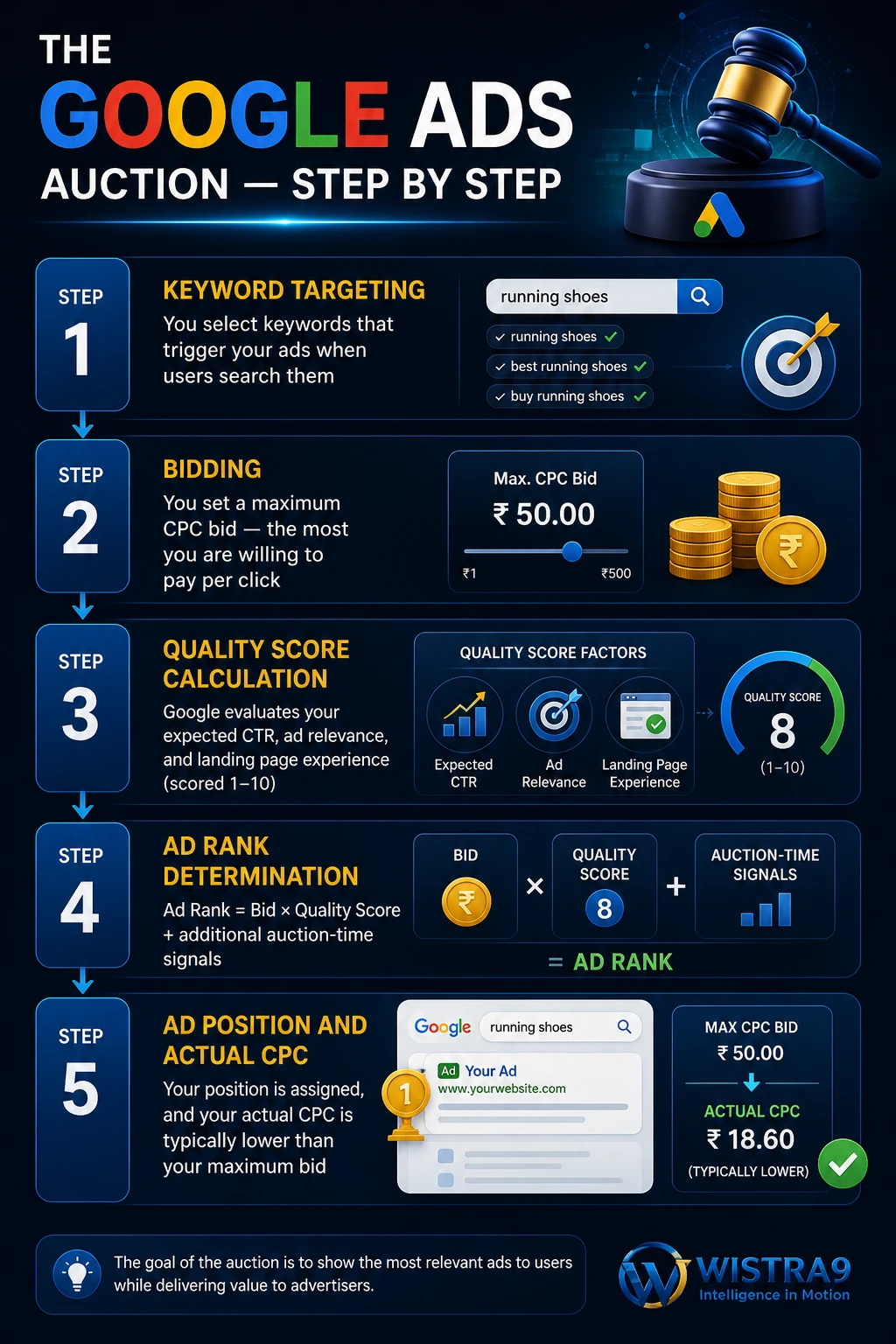
- Step 1 — Keyword targeting: You select keywords that trigger your ads when users search them
- Step 2 — Bidding: You set a maximum CPC bid — the most you are willing to pay per click
- Step 3 — Quality Score calculation: Google evaluates your expected CTR, ad relevance, and landing page experience (scored 1–10)
- Step 4 — Ad Rank determination: Ad Rank = Bid × Quality Score + additional auction-time signals
- Step 5 — Ad position and actual CPC: Your position is assigned, and your actual CPC is typically lower than your maximum bid
What makes up Quality Score:
Component | Weight | How to Improve |
Expected CTR | Highest | Write compelling headlines; match ad to search intent |
Ad Relevance | High | Include the keyword in the headline and description |
Landing Page Experience | High | Fast load time, relevant content, clear CTA |
Types of SEM Campaigns in India
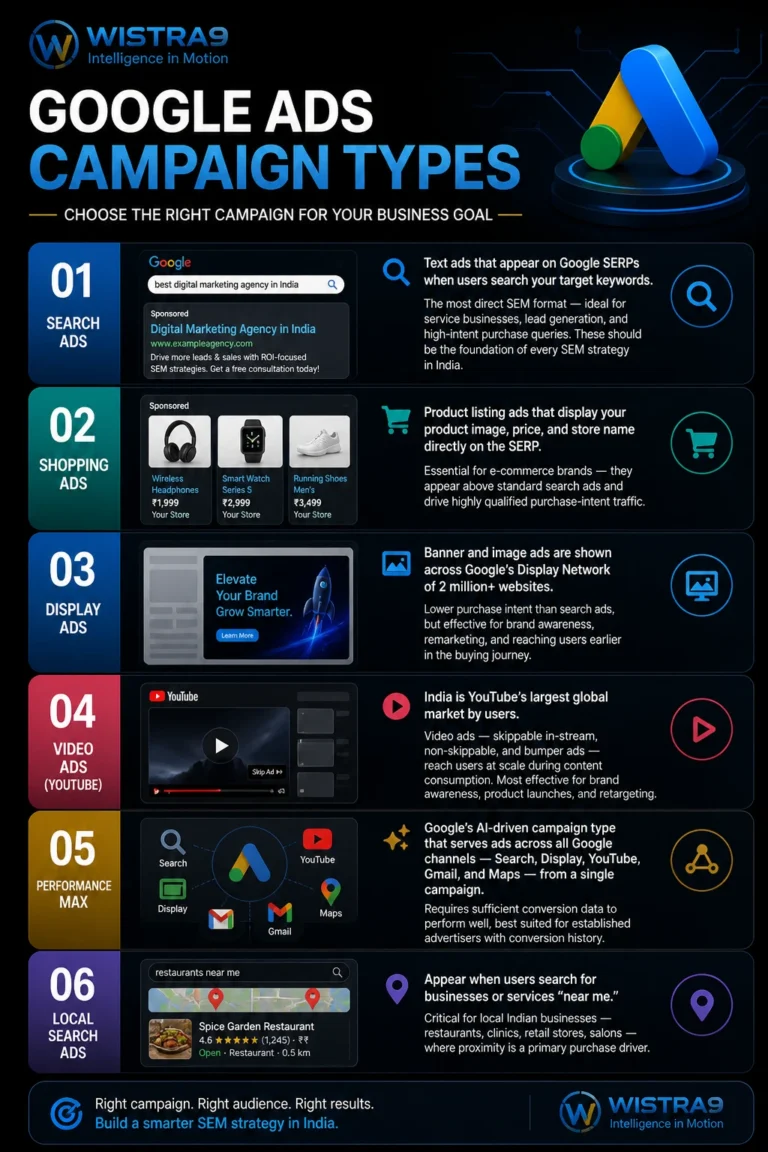
Google Ads offers multiple campaign types. Each serves a different objective — and choosing the right one for your business goal is critical to avoiding wasted spend.
Search Ads: Text ads that appear on Google SERPs when users search your target keywords. The most direct SEM format — ideal for service businesses, lead generation, and high-intent purchase queries. These should be the foundation of every SEM strategy in India.
Shopping Ads: Product listing ads that display your product image, price, and store name directly on the SERP. Essential for e-commerce brands — they appear above standard search ads and drive highly qualified purchase-intent traffic.
Display Ads: Banner and image ads are shown across Google’s Display Network of 2 million+ websites. Lower purchase intent than search ads, but effective for brand awareness, remarketing, and reaching users earlier in the buying journey.
Video Ads (YouTube): India is YouTube’s largest global market by users. Video ads — skippable in-stream, non-skippable, and bumper ads — reach users at scale during content consumption. Most effective for brand awareness, product launches, and retargeting.
Performance Max: Google’s AI-driven campaign type that serves ads across all Google channels — Search, Display, YouTube, Gmail, and Maps — from a single campaign. Requires sufficient conversion data to perform well; best suited for established advertisers with conversion history.
Local Search Ads: Appear when users search for businesses or services “near me.” Critical for local Indian businesses — restaurants, clinics, retail stores, salons — where proximity is a primary purchase driver.
SEM Costs in India — What to Expect in 2026
India’s SEM cost advantage over Western markets is significant. Lower CPCs mean the same budget delivers more clicks, more leads, and higher ROAS — making India one of the most efficient paid search markets globally.
Average CPC by industry in India vs. the USA:
| Industry | Avg. CPC India (₹) | Avg. CPC USA ($) |
|---|---|---|
| Education | ₹15–₹50 | $4–$12 |
| Real Estate | ₹30–₹90 | $8–$20 |
| Healthcare | ₹20–₹60 | $5–$15 |
| Legal Services | ₹60–₹150 | $15–$50 |
| E-commerce / Retail | ₹10–₹35 | $1–$5 |
| B2B / SaaS | ₹50–₹120 | $10–$30 |
Recommended monthly budgets by business size:
| Business Type | Recommended Monthly Budget |
| Local service business | ₹10,000–₹25,000 |
| Regional brand / SMB | ₹30,000–₹1,00,000 |
| National e-commerce | ₹1,00,000–₹5,00,000 |
| Enterprise / high-competition | ₹5,00,000+ |
These are starting benchmarks — actual spend should be driven by your target CPA (Cost Per Acquisition) and business revenue goals, not arbitrary budget caps.
SEM Best Practices for Indian Businesses in 2026
Most SEM campaigns in India underperform not because of budget, but because of avoidable structural and strategic errors. These practices separate campaigns that deliver consistent ROI from those that drain spend with minimal return.
Campaign structure:
- Organise campaigns by product line or service category — never mix unrelated offerings in one campaign
- Group tightly related keywords into small ad groups of 5–15 keywords maximum
- Write ad copy specific to each ad group — generic ads applied across multiple keyword themes kill Quality Score
Keyword strategy:
- Use a mix of broad match (with Smart Bidding), phrase match, and exact match keywords
- Build an aggressive negative keyword list from day one — block irrelevant queries before they consume budget
- In India, always research regional language variants alongside English keywords — Hindi, Tamil, Bengali, and Telugu searches represent significant volume in many categories
Ad copy and landing pages:
- Include the primary keyword in at least one headline
- Use specific, benefit-led CTAs — “Get Free Quote Today” outperforms “Contact Us”
- Every ad should lead to a dedicated landing page — not your homepage
- Mobile optimisation is non-negotiable: 78%+ of searches in India happen on mobile devices
Bidding and optimisation:
- Use Smart Bidding strategies (Target CPA or Target ROAS) once you have 30+ conversions per month of data
- Review Search Terms reports weekly and mine for negative keywords and new keyword opportunities
- A/B test headlines continuously — Google’s Responsive Search Ads allow up to 15 headlines; use them all
Conclusion
Search Engine Marketing is one of the fastest, most measurable ways to grow a business online in India. The combination of immediate visibility, precise targeting, and relatively low CPCs creates a high-ROI environment that few other marketing channels can match.
But SEM rewards discipline. The difference between a campaign that generates consistent leads at a profitable CPA and one that drains budget without results comes down to structure, relevance, and continuous optimisation.
Start with a clearly defined campaign objective. Build a tight keyword list with robust negatives. Write ad copy that earns clicks from the right audience. Send traffic to landing pages built to convert. Then measure, test, and improve every week.
Businesses that treat SEM as a long-term, data-driven investment — not a set-and-forget ad spend — consistently outperform those chasing quick results with poorly structured campaigns.
FAQs about SEM guide
What is SEM in digital marketing?
Search Engine Marketing (SEM) is a form of paid digital marketing where businesses purchase ads that appear on search engine results pages — primarily Google. Ads are triggered by specific keywords and shown to users actively searching for related products or services. SEM operates on a Pay-Per-Click model, meaning you pay only when a user clicks your ad.
What is the difference between SEM and SEO?
SEO (Search Engine Optimisation) builds organic rankings through content, technical improvements, and backlinks — it is free per click but takes 3–6 months to show results. SEM is paid advertising that delivers immediate top-of-page visibility. SEO compounds over time; SEM stops when your budget does. Most businesses benefit from running both simultaneously.
How much does SEM cost in India?
SEM costs in India vary by industry and competition. Average CPCs range from ₹10 to ₹50 for most sectors, making India one of the most cost-efficient paid search markets globally. Small businesses can start with ₹10,000–₹25,000 per month. The budget should be determined by your target cost per lead or acquisition, not a fixed, arbitrary number.
What is Quality Score in Google Ads?
Quality Score is Google’s 1–10 rating of how relevant your keyword, ad copy, and landing page are to the user’s search query. A higher Quality Score lowers your CPC and improves your ad position. It is calculated from three factors: expected click-through rate, ad relevance, and landing page experience.
How long does SEM take to show results?
SEM delivers results within 24–48 hours of launching a campaign — ads go live immediately. However, campaign performance improves significantly over the first 2–4 weeks as Google’s algorithm gathers conversion data and Smart Bidding strategies optimise toward your goals. Expect the first month to be a learning and refinement period.
Is Google Ads the only SEM platform in India?
Google Ads dominates SEM in India with over 95% search market share. Microsoft Advertising (Bing Ads) is available but commands a much smaller audience. For the majority of Indian businesses, Google Ads is the primary and most impactful SEM platform. YouTube Ads — also managed through Google Ads — is an important extension given India’s position as YouTube’s largest market.