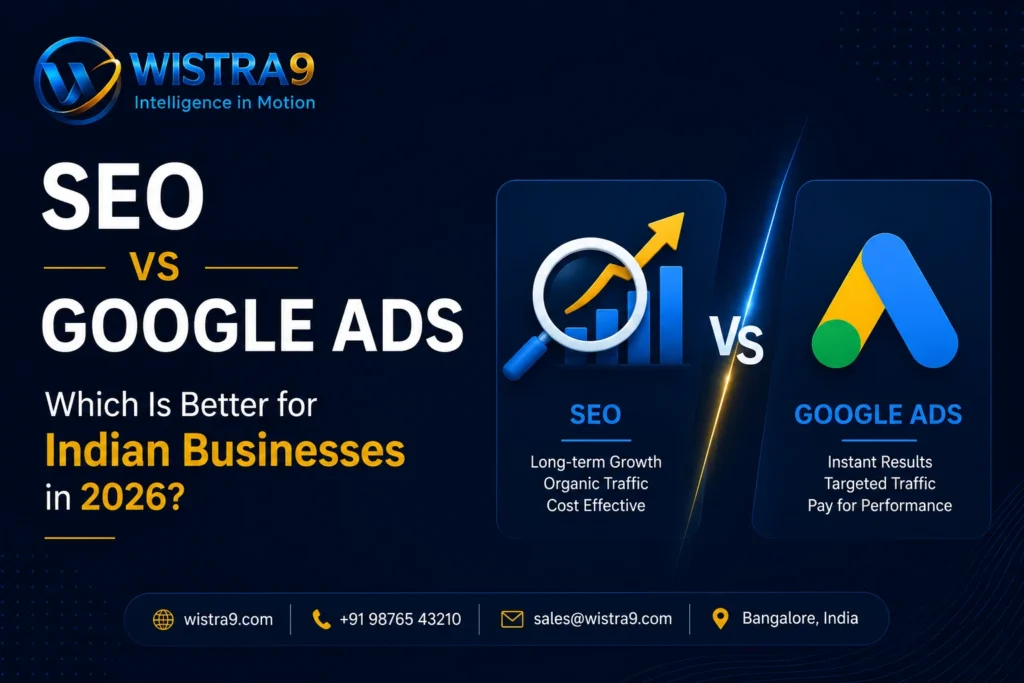
SEO and Google Ads both drive traffic from Google — but they work differently, cost differently, and suit different business situations. SEO (Search Engine Optimisation) builds organic rankings over 3–6 months through content, technical improvements, and backlinks — traffic is free per click and compounds over time. Google Ads delivers paid top-of-page visibility within hours on a Pay-Per-Click model — you pay for every click, and visibility stops when the budget ends. For Indian businesses in 2026: choose Google Ads when you need immediate leads, are launching a product, or operate in a highly competitive niche. Choose SEO when building long-term brand authority, targeting informational queries, or scaling traffic without scaling ad spend. The strongest strategy combines both — Google Ads for immediate revenue while SEO builds compounding organic growth in parallel.
Introduction
Every Indian business investing in digital marketing faces the same question at some point: should the budget go into SEO or Google Ads?
It is not a simple answer — because SEO and Google Ads are not competing strategies. They are complementary channels that serve different purposes, operate on different timelines, and deliver different types of ROI. Understanding what is SEM helps explain how SEO and paid search work together as part of a unified search marketing strategy.
The mistake most businesses make is treating this as an either/or decision. The smarter question is: which one should I prioritise first, and how do I eventually run both effectively?
This guide breaks down SEO vs Google Ads across every dimension that matters for Indian businesses — cost, speed, competition, intent, and long-term return — so you can make an informed, data-backed decision.
KEY TAKEAWAYS
- SEO delivers compounding, zero-cost-per-click traffic — but takes 3–6 months to show results.
- Google Ads generates immediate visibility and leads — but stops the moment your budget does.
- India's low average CPCs make Google Ads more cost-efficient here than in most global markets.
- SEO builds brand authority and trust; Google Ads builds pipeline and revenue fast.
- New businesses and product launches benefit most from starting with Google Ads.
- Established brands with content assets benefit most from SEO investment.
- The highest-performing Indian brands run SEO and Google Ads simultaneously — not in isolation.
What Is the Core Difference Between SEO and Google Ads?
Before comparing the two, it is worth being precise about what each channel actually does — because the terminology is often confused in the Indian market.
SEO (Search Engine Optimisation) is the process of improving your website's content, technical health, and backlink profile so that Google ranks your pages higher in organic (unpaid) search results. Rankings built through SEO are not purchased — they are earned.
Google Ads is a paid advertising platform where you bid on keywords and pay each time a user clicks your ad. Your ad appears above organic results, marked "Sponsored." Visibility is immediate but directly tied to continuous spend.
Factor | SEO | Google Ads |
|---|---|---|
Cost model | Time and resource investment | Pay-Per-Click (CPC) |
Speed to results | 3–6 months | Within 24–48 hours |
Longevity | Compounds and grows over time | Stops when budget ends |
Click cost | Zero per click once ranked | ₹10–₹150 per click (varies by niche) |
SERP position | Below paid ads | Above organic results |
Trust perception | Higher — organic results are trusted more | Lower — users know it is an ad |
Targeting control | Limited — Google decides who sees you | Full — location, device, time, audience |
Scalability | Scales without proportional spend increase | Scales directly with budget |


When Google Ads Is the Right Choice for Indian Businesses
Google Ads is not always the better option — but there are specific situations where it is clearly the correct first move. Choosing Google Ads when you need it can be the difference between building momentum and waiting months for organic traffic that may never arrive.
Google Ads works best when:
- You need leads or sales immediately — a new business, a product launch, or a seasonal campaign cannot wait 6 months for SEO to mature. Google Ads delivers traffic within hours of going live.
- You operate in a high-competition niche — industries like real estate, insurance, legal services, and education have thousands of established websites competing for the same organic keywords. Google Ads lets you bypass that competition by buying top-of-page placement.
- You are testing a new product or market — before investing months in SEO content for a product you are not sure will sell, Google Ads lets you validate demand quickly with a modest budget.
- You have strong offers tied to urgency — limited-time discounts, seasonal sales, or event-driven promotions need to convert in a short window. Google Ads is built for that.
- You want precise audience control — Google Ads lets you target by city, device, time of day, and even specific audience segments. SEO cannot replicate that precision.
Google Ads cost reality for India in 2026:
Niche | Average CPC (India) | Avg. Monthly Budget to Generate 100 Clicks |
|---|---|---|
Education | ₹15–₹50 | ₹1,500–₹5,000 |
Healthcare | ₹20–₹60 | ₹2,000–₹6,000 |
Real Estate | ₹30–₹90 | ₹3,000–₹9,000 |
Legal Services | ₹60–₹150 | ₹6,000–₹15,000 |
E-commerce / Retail | ₹10–₹35 | ₹1,000–₹3,500 |
India’s CPCs remain significantly lower than US and European benchmarks — making Google Ads a highly efficient channel for Indian businesses relative to global competitors.
When SEO Is the Right Choice for Indian Businesses
SEO is a long-term compounding investment. Businesses that commit to it consistently build organic traffic that no ad budget cut can take away — and that traffic cost reduces on a per-click basis month over month as rankings strengthen.
SEO works best when:
- You are building a long-term brand — organic rankings build credibility and trust in a way paid ads cannot replicate. Users consistently trust organic results more than sponsored placements.
- You are targeting informational queries — blog content, guides, and educational resources rank organically and attract users earlier in the buying journey. Google Ads targeting these queries is often inefficient.
- Your business model cannot sustain ongoing ad spend — subscription businesses, content platforms, and service businesses with lower margins benefit disproportionately from organic traffic that does not come with a per-click cost.
- You operate in a niche with low keyword difficulty — if your competitors have weak organic presence, SEO can deliver rankings faster and with less investment than in competitive markets.
- You are building a content-driven authority strategy — comparison pages, how-to guides, and educational content compound in value over time and support the entire marketing funnel.
SEO timeline reality for Indian businesses:
SEO Activity | When Results Typically Appear |
|---|---|
Technical fixes (crawl errors, speed) | 2–4 weeks |
New blog content ranking | 3–5 months |
Category / service page ranking | 4–8 months |
Domain authority increase | 6–12 months |
Compounding organic traffic growth | 12+ months of consistent effort |
Cost Comparison — SEO vs Google Ads Over 12 Months
The cost comparison between SEO and Google Ads is frequently misunderstood. Google Ads looks cheaper in month one. SEO looks cheaper after month twelve. The right comparison is total investment vs total return over a meaningful timeframe.
Scenario: Indian SMB targeting “digital marketing services Mumbai”
| Month | Google Ads Spend (₹) | Cumulative Ads Cost | SEO Investment (₹) | Cumulative SEO Cost | Organic Clicks from SEO |
|---|---|---|---|---|---|
| 1–3 | ₹30,000/mo | ₹90,000 | ₹20,000/mo | ₹60,000 | 0–50/mo |
| 4–6 | ₹30,000/mo | ₹1,80,000 | ₹20,000/mo | ₹1,20,000 | 100–300/mo |
| 7–12 | ₹30,000/mo | ₹3,60,000 | ₹15,000/mo | ₹2,10,000 | 400–800/mo |
By month 12, Google Ads has cost ₹3.6 lakh and delivers traffic only as long as spend continues. SEO has cost ₹2.1 lakh and now delivers 600–800 monthly organic clicks at zero additional cost per click — with that traffic continuing to grow beyond month 12.
The key insight:Google Ads cost is linear. SEO return is exponential. The crossover point where SEO delivers better ROI than Google Ads typically arrives between months 8–14 for most Indian businesses.
SEO vs Google Ads — A Side-by-Side Decision Guide
The right channel depends on your business stage, budget, timeline, and objective. Use this framework to determine where to focus first.
Business Situation | Recommended Channel | Reason |
|---|---|---|
New business, no organic traffic | Google Ads first | Cannot afford to wait 6 months for SEO |
Established site, strong content | SEO + Google Ads | Compound organic while ads fill immediate pipeline |
Seasonal business (festive, travel) | Google Ads | Short windows need immediate, controllable visibility |
E-commerce with product catalogue | Both simultaneously | Shopping Ads for immediate sales; SEO for category rankings |
Local service business (clinic, salon) | Google Ads + Local SEO | Immediate local leads + Google Business Profile optimisation |
SaaS / subscription product | SEO-led with retargeting Ads | Content drives awareness; ads re-engage high-intent visitors |
Low-margin business | SEO priority | Per-click costs erode margins; organic traffic has no CPC |
High-competition national market | Google Ads + long-tail SEO | Compete immediately via ads; dominate long-tail organically |
Running SEO and Google Ads Together — The Smartest Strategy
The most successful Indian brands in 2026 do not choose between SEO and Google Ads. They run both as integrated channels — each strengthening the other.
How they work together:
- Google Ads data improves SEO strategy — Search Terms reports reveal exactly which queries convert. Use this data to prioritise SEO content topics and keywords that already drive paid conversions.
- SEO content improves Google Ads Quality Score — A well-optimised, fast, relevant landing page improves Quality Score, which lowers your CPC and improves ad position without increasing spend.
- SERP domination — appearing in both paid and organic positions on the same search result page doubles your visibility, increases brand trust, and significantly reduces competitor click-through rates.
- Budget efficiency — as SEO matures and organic clicks increase, you can reduce Google Ads spend on those keywords and redirect budget toward new keywords or audiences — stretching the total marketing budget further.
The recommended approach for most Indian businesses:
- Months 1–3: Lead with Google Ads for immediate pipeline. Begin SEO foundational work simultaneously (technical audit, keyword mapping, content plan).
- Months 4–8: Maintain Google Ads. Publish SEO content consistently. Monitor early rankings.
- Months 9–12: Reduce Google Ads spend on keywords where organic rankings have matured. Reinvest into new Google Ads targeting or scaling SEO content production.
Conclusion
SEO and Google Ads are not rivals. They are the two most powerful search channels available to Indian businesses — and they are most effective when treated as a coordinated strategy rather than an either/or decision.
Google Ads wins on speed, precision, and control. SEO wins on compounding ROI, brand trust, and long-term cost efficiency. The businesses that grow fastest are those that use Google Ads to fund early growth while SEO builds the organic asset base that reduces paid dependency over time.
Start with whichever channel your current business stage demands. But plan from day one to run both.
Is SEO or Google Ads better for small businesses in India?
For most small businesses in India, Google Ads delivers faster results — leads within days rather than months. However, SEO should run in parallel from the beginning. Small businesses with limited budgets can start with a modest Google Ads spend of ₹10,000–₹15,000 per month while investing in foundational SEO work like Google Business Profile optimisation, on-page SEO, and consistent blog content.
Which is cheaper — SEO or Google Ads?
Google Ads has a higher short-term cash cost because you pay per click. SEO has a higher time cost but zero cost per organic click once rankings are established. Over 12 months, SEO typically delivers a lower cost per visitor than Google Ads in most Indian niches — though the crossover point varies by competition level and SEO execution quality.
How long does SEO take to rank in India?
Most new or underoptimised pages take 3–6 months to show meaningful ranking movement on Google India. Competitive keywords in industries like real estate, education, and legal services can take 8–14 months. Technical fixes show faster results — often within 2–4 weeks. Consistency matters more than speed: sites that publish and optimise continuously outperform those that work in bursts.
Can I run Google Ads and SEO at the same time?
Yes — and for most businesses this is the recommended approach. Running both simultaneously allows Google Ads to generate immediate revenue while SEO builds compounding organic authority. Google Ads conversion data also improves SEO keyword targeting, and strong landing pages built for ads improve the Quality Score that lowers your CPC.
Does Google Ads help SEO rankings?
No — Google Ads spend does not directly improve organic SEO rankings. Google's paid and organic search algorithms are entirely separate. However, Google Ads indirectly supports SEO by driving traffic that generates engagement signals, testing which content converts (informing your SEO content strategy), and improving landing page quality that also benefits organic pages.
Which is better for e-commerce in India — SEO or Google Ads?
E-commerce benefits significantly from both. Google Shopping Ads capture high-intent purchase queries immediately and are one of the most efficient paid channels for product-based businesses. SEO builds category page authority that drives zero-CPC traffic at scale over time. Indian e-commerce brands that consistently invest in both channels outperform those relying on either alone.