
Local SEO in India is no longer optional — it is the primary growth lever for any business that depends on customers in a specific city or region. Whether you run an SEO agency in Bangalore, a clinic in Jaipur, or a boutique in Mumbai, local SEO determines whether you show up when your ideal customer searches for you. This local SEO guide walks you through exactly what works in India in 2026, step by step.
Before we dive in, here is the short version: local SEO success in India comes down to five pillars — your Google Business Profile, your on-page signals, your reviews, your citations, and your content strategy. Get all five right, and you will rank above competitors who have been in business far longer than you. Let us start from the top.
Why Local SEO Matters More Than Ever in India in 2026
India now has over 900 million internet users, with the majority accessing the web via mobile. "Near me" searches have grown over 80% in the past two years across Tier 1 and Tier 2 cities. Google's local algorithm has become far more sophisticated — rewarding businesses that demonstrate genuine local authority and proximity, not just the ones with the most backlinks.
For businesses in cities like Bangalore, Mumbai, Hyderabad, Jaipur, and Pune, a strong local SEO presence is no longer optional. It is the difference between a full calendar and an empty one.
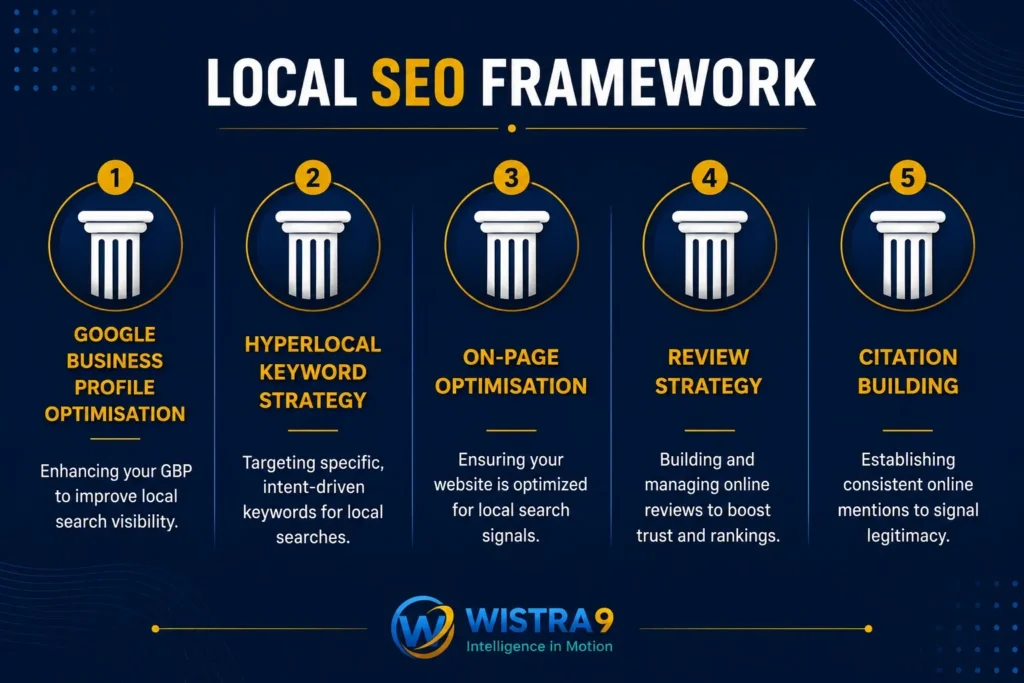
Local SEO Pillar 1: Google Business Profile Optimisation
Your Google Business Profile (GBP) is your most powerful local SEO asset — and most Indian businesses are leaving significant ranking potential untouched.
Complete Every Section
GBP completion is directly correlated with local pack rankings. Fill in your business name, address, phone, website, hours (including special hours for holidays), and business description. Use your primary keyword naturally in the description — do not keyword-stuff.
Choose the Right Primary Category
Your primary category carries the most ranking weight. Be specific: “Digital Marketing Agency” rather than “Marketing Agency”; “Orthopedic Surgeon” rather than “Doctor”. Add relevant secondary categories, but keep them accurate — irrelevant categories hurt more than they help.
GBP Posts: Publish Weekly
GBP posts are underused by Indian businesses. Publishing weekly updates — service spotlights, offers, FAQs, event announcements — keeps your profile active and signals relevance to Google. Each post is an opportunity to include a keyword naturally.
Photos and Videos: Quality Over Quantity
Profiles with 10+ high-quality photos receive significantly more direction requests and website clicks. Upload photos of your exterior, interior, team, and products or services. Add geo-tagged images where possible — this sends a location signal to Google.
Local SEO Pillar 2: Hyperlocal Keyword Strategy
Generic keywords like “SEO services” or “interior designer” are impossible to rank for locally without a significant domain authority. The opportunity in 2026 lies in hyperlocal, intent-specific keywords.
Build Around Location Modifiers
Structure your keyword research around three layers:
- City-level: “digital marketing agency Bangalore”
- Area-level: “SEO services Koramangala” or “SEO agency HSR Layout”
- Near-me intent: “SEO consultant near Indiranagar”
Target Question-Based Queries
AI Overviews and featured snippets are now appearing for a large share of local queries. Structuring your content to answer specific questions — “how much does SEO cost in Bangalore”, “best time to hire an SEO agency in India” — increases your visibility in both traditional results and AI-generated answers.
Map Your Service Pages to Specific Localities
If you serve multiple areas, create individual service location pages. A Bangalore-based agency serving Whitefield, Electronic City, and Hebbal should have dedicated pages for each — with unique content, local testimonials, and area-specific case studies. Do not duplicate content across these pages.
Local SEO Pillar 3: On-Page Optimisation
Your website needs to clearly communicate where you are and who you serve. These elements matter most:
- NAP consistency: Your Name, Address, and Phone number must be identical across your website, GBP, and every directory listing. Even minor variations (“St.” vs “Street”) create conflicting signals.
- LocalBusiness schema markup: Add structured data to your website to help Google understand your business type, location, service area, and hours. This is still underutilised by most Indian SMEs.
- City + service in your H1 and title tag: “SEO Agency in Bangalore | Wistra” is more effective locally than “Leading Digital Marketing Company”.
- Embed a Google Map: Embedding a GBP map on your contact page sends a geographic relevance signal and improves the user experience for visitors trying to find you.
Local SEO Pillar 4: Review Strategy
Google’s local algorithm weighs review quantity, quality, recency, and your response rate. In 2026, review velocity — how consistently you are receiving new reviews — is a significant ranking factor.
Build a Review Generation System
Do not ask for reviews sporadically. Build a repeatable process: send a review request via WhatsApp or SMS within 24 hours of a successful service delivery. Make it frictionless — share a direct GBP review link. Aim for at least 4 to 6 new reviews every month.
Respond to Every Review
Responding to reviews — positive and negative — demonstrates engagement and signals to Google that your business is active. For negative reviews, respond professionally and offer to resolve the issue offline. Never argue publicly.
Leverage Review Keywords
When customers mention specific services or locations in reviews (“great SEO work for our Pune store”), Google registers these as keyword signals. Gently encourage specific feedback by asking: “What service did we help you with, and where are you based?”
Local SEO Pillar 5: Citation Building for Indian Businesses
Citations are mentions of your business’s NAP across the web — directories, review sites, news articles. In India, the most impactful citation sources in 2026 are:
- Justdial and Sulekha (high domain authority, widely used)
- IndiaMart (for B2B businesses)
- Bing Places and Apple Maps (often neglected but increasingly important)
- Industry-specific directories (healthcare, legal, education, real estate)
- Local news and regional business listings
Prioritise accuracy and consistency over volume. Twenty accurate, well-maintained citations are worth more than two hundred sloppy ones with inconsistent NAP data.
Local SEO and AI Search: GEO and AEO in 2026
Google’s AI Overviews now appear for a significant share of local queries. Businesses that appear in AI-generated answers receive a disproportionate share of brand visibility — even when the user does not click through to the website.
To improve your visibility in AI search results:
- Write content that directly answers specific questions your customers ask
- Use structured formats — numbered lists, definition paragraphs, comparison tables
- Ensure your GBP, website, and third-party mentions tell a consistent story about what you do and where you operate
- Build topical authority in your service area — a cluster of well-linked, relevant local content signals expertise to both Google and AI models
How to Measure Local SEO Performance
Tracking the right metrics prevents you from optimising in the wrong direction. Focus on:
- GBP Insights: Direction requests, calls from profile, website clicks — these are direct business signals
- Local pack rankings: Track your position for your primary keywords in your target city and area
- Organic traffic from local queries: Use Google Search Console to filter for location-specific queries
- Review velocity: Number of new reviews per month and average rating trend
- Conversion rate by city page: If you have location landing pages, track which ones are generating enquiries
Local SEO Quick-Win Checklist for 2026
- Audit your GBP for completeness — fill every field
- Add LocalBusiness schema to your homepage and contact page
- Create or update one location-specific service page this month
- Set up a WhatsApp review request template and send it after every successful job
- Check NAP consistency across your top 10 directory listings
- Publish one GBP post this week with a target keyword in the first sentence
- Respond to all unanswered reviews on your profile today
Want a Free Local SEO Audit for Your Business?
Wistra offers complimentary local SEO audits for Indian businesses — we will tell you exactly where you are losing rankings and what to fix first.