

A technical SEO checklist for Indian websites in 2026 must cover seven areas a global checklist usually skips: Core Web Vitals tuned for mid-range Android devices on Indian mobile networks, DPDP Act 2023 data-residency rules, hreflang for India's 22 official languages, India-based hosting/CDN nodes, NAP and LocalBusiness schema consistency, AI crawler access (GPTBot, ClaudeBot, PerplexityBot) in robots.txt, and India-specific structured data for local search. Most "technical SEO checklists" published for an Indian audience are simply US/UK checklists with the currency symbol changed.
Key Takeaways
- 96%+ of Indian internet traffic is mobile, and a large share of it runs on mid-range Android devices on 4G — not the flagship phones most Core Web Vitals testing defaults assume.
- The DPDP Act 2023 is now a technical SEO and infrastructure decision, not just a legal one — where you host data affects site architecture, vendor choice, and even CDN configuration.
- Generic checklists ignore multilingual India. If your site serves Hindi, Tamil, Kannada, Bengali, or Marathi versions, hreflang and canonical mistakes are far more common — and far more damaging — than in single-language markets.
- AI crawler policy (GPTBot, ClaudeBot, PerplexityBot, Google-Extended) belongs in your robots.txt audit now, not as an afterthought — Indian B2B and SaaS sites are starting to show up (or not) in ChatGPT, Claude, and Perplexity answers based on this.
- Cheap shared hosting and plugin-heavy WordPress builds — extremely common among Indian SMBs and D2C brands — are the single biggest cause of failed Core Web Vitals scores in this market.
- This is a working checklist, not a theory document. Each section below is something a developer can action in a sprint.
Why Most "Technical SEO Checklists" Don't Work for Indian Websites
Search for a technical SEO checklist India teams can actually use, and you’ll get the same fifteen generic items every time: fix your sitemap, check your robots.txt, compress your images, add HTTPS. None of that is wrong. It’s also not enough if your users are in Jaipur on a ₹8,000 Android phone over a patchy 4G connection, your stack runs on a ₹3,000-a-year shared hosting plan in Mumbai, your audience expects content in two or three languages, and your legal team just asked Engineering what the DPDP Act means for where customer data lives.
That’s the gap. Western checklists are built for a market where broadband is fast and uniform, hosting is rarely the bottleneck, single-language sites are the default, and data protection law has been stable for years. None of those assumptions hold in India in 2026.
This checklist is built around what’s actually different here:
| What generic checklists assume | What’s actually true in India |
|---|---|
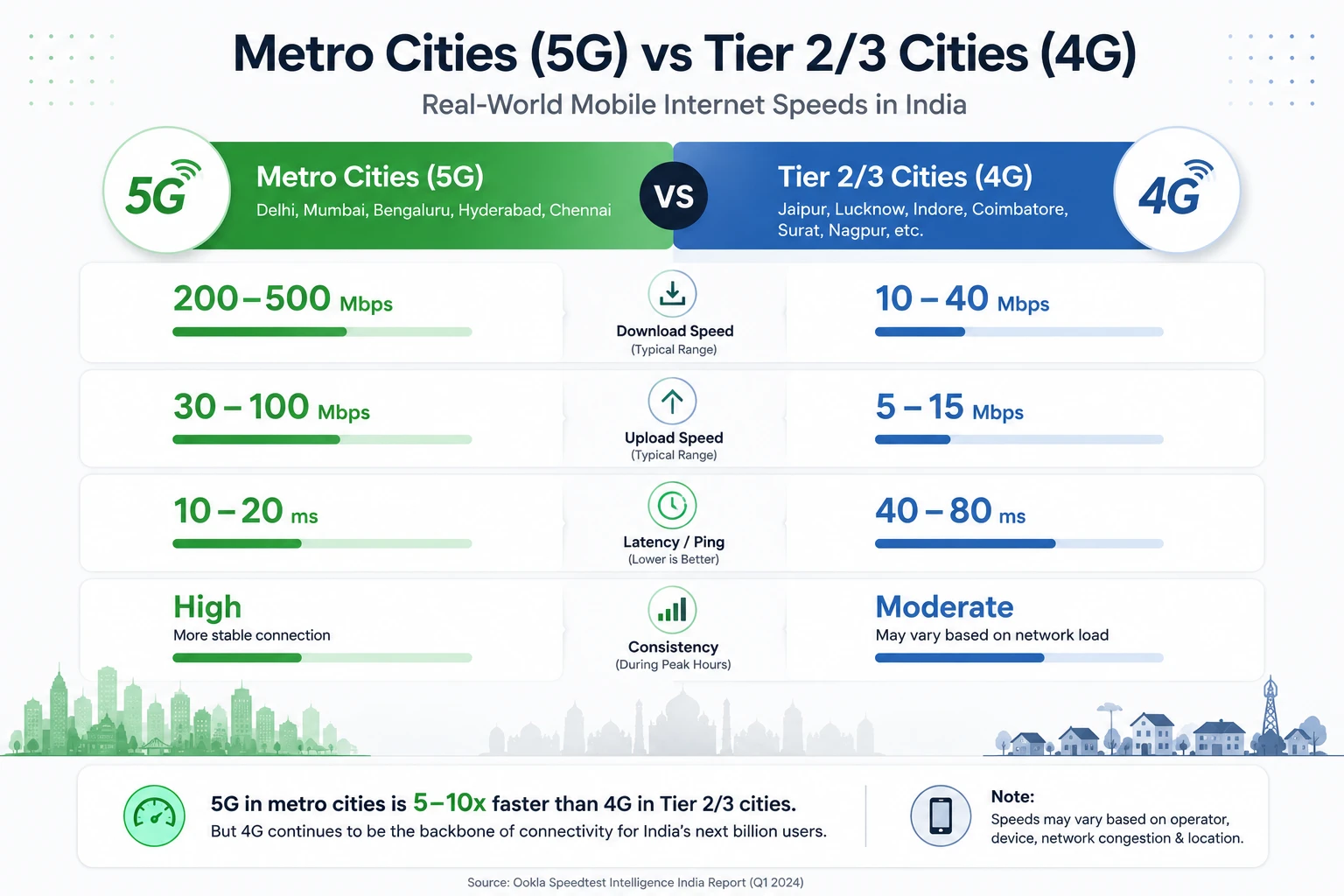
| Most users are on fast broadband or 5G | India had roughly 1.03 billion internet users at the end of 2025, with internet penetration at 70.0 percent of the population, but speeds vary enormously between metro 5G and Tier 2/3 4G |
| Performance testing on a flagship device is representative | The majority of Indian smartphone owners use mid-range or budget Android devices with weaker CPUs and less RAM |
| One language, one site | India has 22 scheduled languages; most serious B2C and government-adjacent sites need at least Hindi + English, often more |
| Data residency is a legal footnote | The DPDP Act 2023 and sector rules (RBI, IRDAI) directly affect hosting and architecture decisions |
| Hosting quality is consistent | Indian SMBs disproportionately run on budget shared hosting, which directly hurts TTFB and LCP |
| AI crawlers are a “nice to have” | AI search referral traffic is growing fast, and most Indian business sites have never reviewed their robots.txt for AI bots |
If your buyer is a CTO, this is the framing that earns credibility — not another “use HTTPS” bullet point.
The 2026 Technical SEO Checklist for Indian Websites
1. Crawlability & Indexation
The fundamentals still matter — they’re just not where most Indian sites lose the most points.
| Check | Why it matters in India | Priority |
|---|---|---|
robots.txt exists, isn’t blocking CSS/JS, references the sitemap | Many Indian WordPress installs ship with security plugins that accidentally block resource files | Critical |
| XML sitemap is current, excludes noindex/404/redirected URLs | Multilingual sites often generate duplicate sitemaps per language that conflict | High |
Canonical tags are self-referencing and consistent across www/non-www, http/https | Indian sites frequently migrate from http://www.site.in to https://site.com without cleaning up canonicals | Critical |
No orphaned pages from old .in → .com migrations | Many Indian businesses started on a .in domain and later moved to .com (or vice versa) without proper 301 mapping | High |
Pagination and filter URLs use canonical/noindex correctly | Common on Indian e-commerce and real estate sites with heavy faceted navigation | Medium |
2. Core Web Vitals & Performance (Tuned for Indian Network Conditions)
This is the section where generic checklists do the most damage — they tell you the thresholds but not the context.
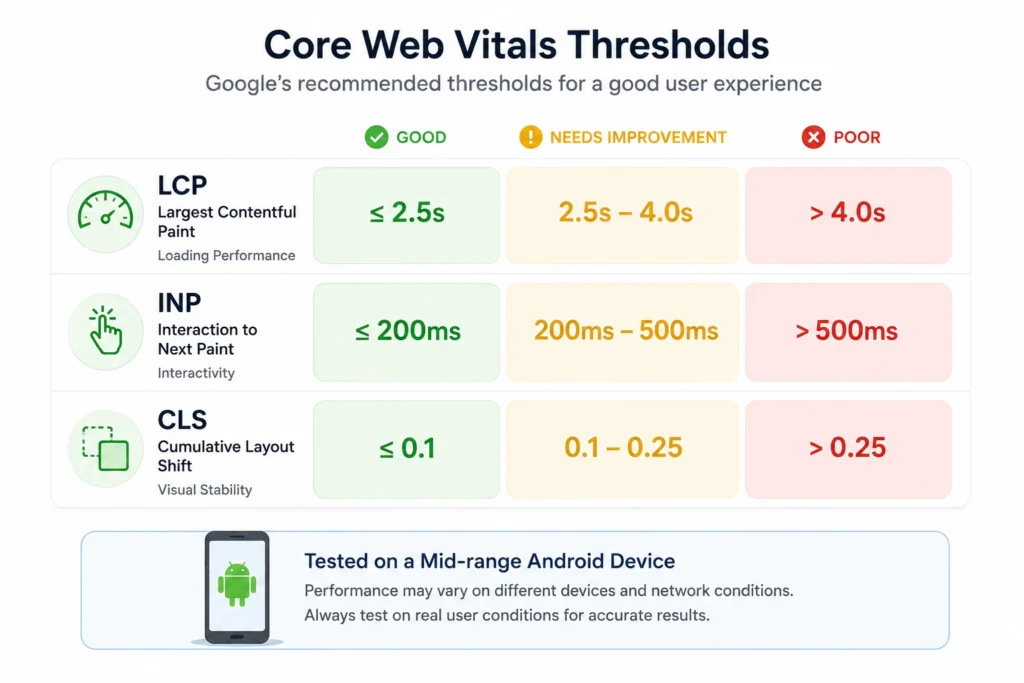
The official Google thresholds for 2026 (measured as real-user field data, 75th percentile, over a rolling 28-day window in Chrome UX Report — not a lab score):
| Metric | What it measures | “Good” threshold |
|---|---|---|
| LCP (Largest Contentful Paint) | Loading speed of the main visible element | Under 2.5 seconds |
| INP (Interaction to Next Paint) | Responsiveness across every interaction, not just the first click | Under 200 milliseconds |
| CLS (Cumulative Layout Shift) | Visual stability while the page loads | Under 0.1 |
A page only gets an overall “Good” rating when all three pass at once for at least 75% of real visits — one weak metric fails the whole group.
Why is this harder in India specifically:
- Mid-range Android devices have noticeably weaker JavaScript execution speed than the iPhones and high-end Android devices most performance benchmarks are run on — this disproportionately hurts INP, which is now a full ranking-tier metric and the most commonly failed of the three.
- Payment gateway widgets (Razorpay, Paytm, PhonePe), chat widgets, and third-party analytics tags are heavily used by Indian D2C and SaaS sites and are a top cause of blocked main threads and poor INP.
- Shared hosting — still extremely common for Indian SMB WordPress sites — frequently pushes Time to First Byte (TTFB) well past 200ms before any rendering even starts, which drags down LCP regardless of front-end optimization.
Checklist:
| Check | Priority |
|---|---|
| TTFB under 200ms (test from an Indian server location, not just a US-based tool) | Critical |
| Hero/LCP image preloaded, served as WebP/AVIF, correctly sized — not just compressed | Critical |
| Third-party scripts (payment widgets, chat, ads, analytics) deferred or loaded async | Critical |
| JavaScript bundle audited for unused/duplicate libraries (common in agency-built WordPress themes) | High |
font-display: swap (or optional) set for web fonts, especially for Devanagari/regional scripts which are often heavier font files | High |
| Images/ads/cookie banners reserve layout space to prevent CLS | High |
| CDN configured with a Points of Presence (PoP) inside India, not just a global default | High |
| HTTP/2 or HTTP/3 enabled at the server/CDN level | Medium |
3. Mobile Experience
With 96.6% of Indian internet users accessing the internet via mobile devices, including 94.7% via smartphones, “mobile-friendly” isn’t a checkbox — it’s the primary experience.
- Viewport meta tag present, no horizontal scroll on common Indian device widths (360–412px is the dominant range, not 414px+ iPhone widths)
- Touch targets at least 44×44px — important for forms with regional-language labels, which run longer than their English equivalents
- Body text 16px minimum without requiring zoom
- No intrusive interstitials (a common Indian D2C pattern — WhatsApp popups, coupon modals — that actively hurt mobile usability scores)
- Mobile-first CSS, tested against real mid-range Android devices, not just Chrome DevTools device emulation
4. Security, HTTPS & India-Specific Compliance

This is the section almost no global “technical SEO checklist” includes — and it’s becoming a CTO-level concern fast.
- HTTPS everywhere, no mixed content, HTTP → HTTPS redirects in place, HSTS configured
- No exposed .env, .git, or config files (a recurring finding in Indian SMB site audits, especially on shared hosting)
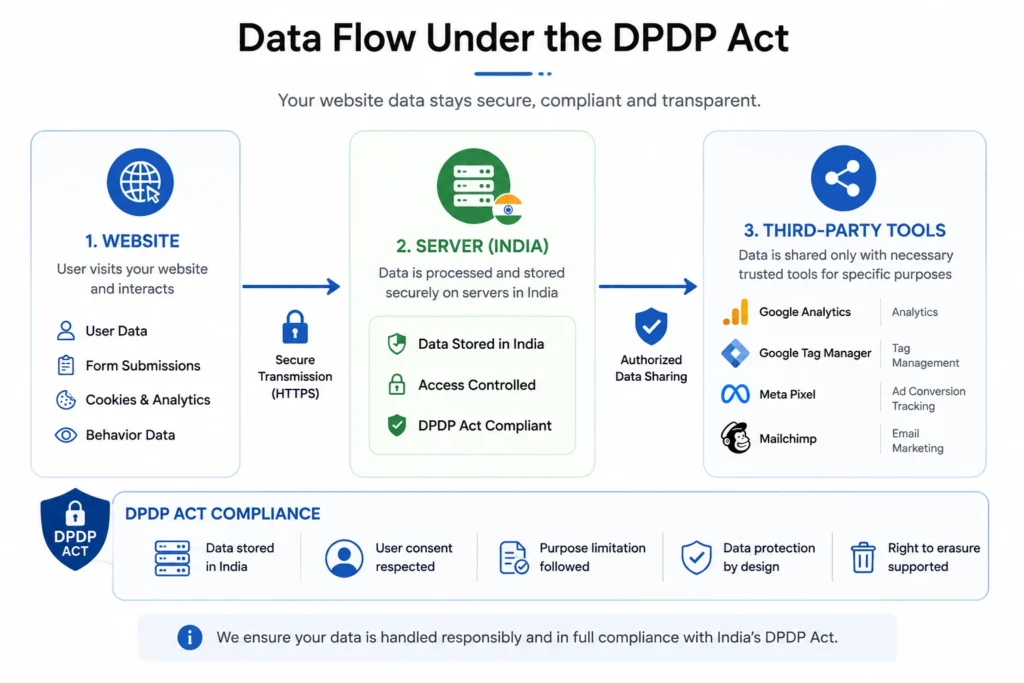
- DPDP Act 2023 readiness: The Act doesn’t mandate blanket data localization, but it requires Sensitive Personal Data and Critical Personal Data to be stored and processed within India, and the Reserve Bank of India separately mandates that payment system data be stored exclusively within India. If your stack touches health, financial, or biometric data, this directly affects database region selection (e.g., AWS ap-south-1), backup architecture, and which third-party tools you’re allowed to pipe customer data through.
- Document your data flow: which forms collect personal data, where it’s stored, and which vendors (CRM, email, analytics) process it outside India — this is now a question Legal will ask Engineering, and it overlaps directly with cookie consent and tag manager setup.
- Cookie/consent banners reviewed for both DPDP and the practical SEO cost of layout shift (a common CLS failure point)
5. Structured Data & Schema
- JSON-LD validates with no errors (Google’s Rich Results Test)
- Organization schema with consistent NAP (Name, Address, Phone) — this is one of the most common Indian SMB failures, where the footer, Google Business Profile, and schema markup all list slightly different addresses or phone formats (a missing +91, a “Bangalore” vs “Bengaluru” mismatch, an old office address)
- LocalBusiness schema for businesses with a physical India location, with areaServed set correctly for city/region targeting
- FAQPage schema matching any on-page FAQ content (see the JSON-LD example at the end of this article)
- BreadcrumbList schema for sites with deep navigation (common on Indian e-commerce and real estate platforms)
- Schema language fields (inLanguage) are set correctly on multilingual pages
6. Multilingual & Regional Language SEO

If your site serves more than English, this is where most technical SEO mistakes in India actually live.
| Check | Priority |
|---|---|
hreflang tags present and reciprocal across all language versions (a missing return tag is the most common error) | Critical |
| Each language version has its own indexable URL (subdirectory or subdomain) — not JS-toggled content with one URL | Critical |
lang attribute on <html> matches the actual page language | High |
x-default hreflang set for the language-selector or country-neutral page | Medium |
| No machine-translated content published without human review (a quality signal Google has gotten stricter about) | Medium |
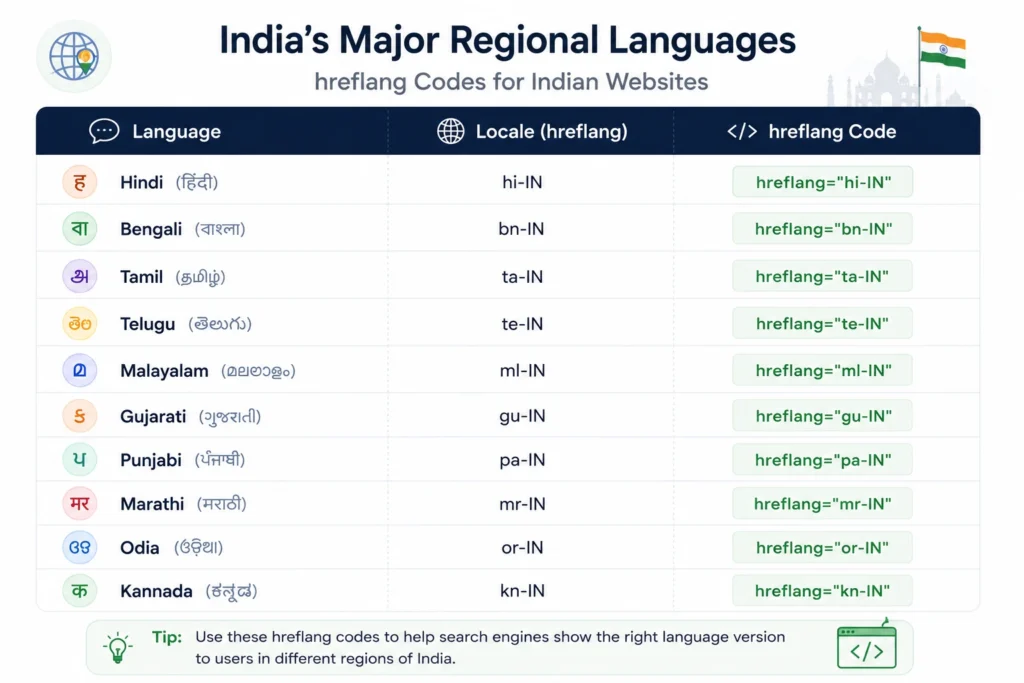
Common Indian language codes for hreflang:
| Language | hreflang code |
|---|---|
| Hindi | hi-IN |
| Tamil | ta-IN |
| Telugu | te-IN |
| Kannada | kn-IN |
| Bengali | bn-IN |
| Marathi | mr-IN |
| Gujarati | gu-IN |
| English (India) | en-IN |
7. Hosting & Infrastructure
- Primary hosting region inside India (Mumbai/ap-south-1 is the most common compliance-ready choice), where data residency or RBI rules apply
- CDN with edge nodes in India (not just Singapore or a global default) to cut latency for the 4G majority
- Server response time benchmarked from an Indian vantage point — a TTFB test run from a US-based tool will look fine while real Indian users see something much slower
- Database and asset backups documented for the region (relevant both for DPDP and basic disaster recovery)
- Shared hosting flagged as a performance risk for any business beyond the smallest brochure site — this is the single most common root cause behind failed Core Web Vitals in Indian SMB audits
AI Search & LLM Crawler Readiness (New for 2026)

This wasn’t on any technical SEO checklist three years ago. It is now.
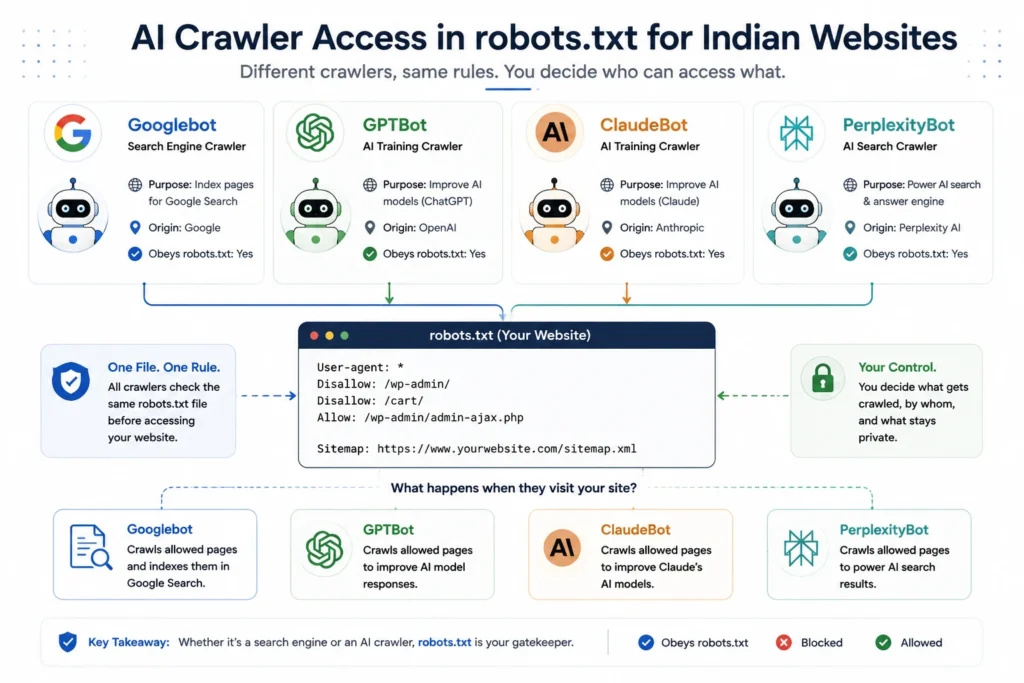
AI assistants like ChatGPT, Claude, and Perplexity run their own crawlers, separate from Googlebot. AI crawler management means controlling and monitoring bots like GPTBot (OpenAI), ClaudeBot (Anthropic), PerplexityBot, and Google-Extended through robots.txt directives. Most enterprises in 2026 allow major search-time bots for citation visibility while selectively blocking training-only crawlers such as CCBot.
For most Indian B2B, SaaS, and services businesses where the goal is to be cited and recommended by AI tools (not to opt out of AI entirely), the practical move is:
# Allow AI search/citation bots
User-agent: OAI-SearchBot
User-agent: ChatGPT-User
User-agent: PerplexityBot
User-agent: Claude-SearchBot
User-agent: Claude-User
Allow: /# Default rule for everyone else
User-agent: *
Allow: /
Disallow: /wp-admin/
Disallow: /checkout/
Disallow: /cart/Sitemap: https://yourdomain.com/sitemap.xml
Checklist:
| Check | Priority |
|---|---|
robots.txt audited for accidental Disallow: / blocking everything (common after a security plugin update) | Critical |
| Explicit decision made (and documented) on whether to allow or block GPTBot, ClaudeBot, and PerplexityBot — don’t let it happen by default | High |
| Content structured with clear headings, direct answers, and current data so that if a crawler is allowed in, the content is actually citable | High |
Google-Extended reviewed separately — it controls Gemini/AI training access, independent of regular Search indexing | Medium |
Quick-Reference Checklist (Save or Print)
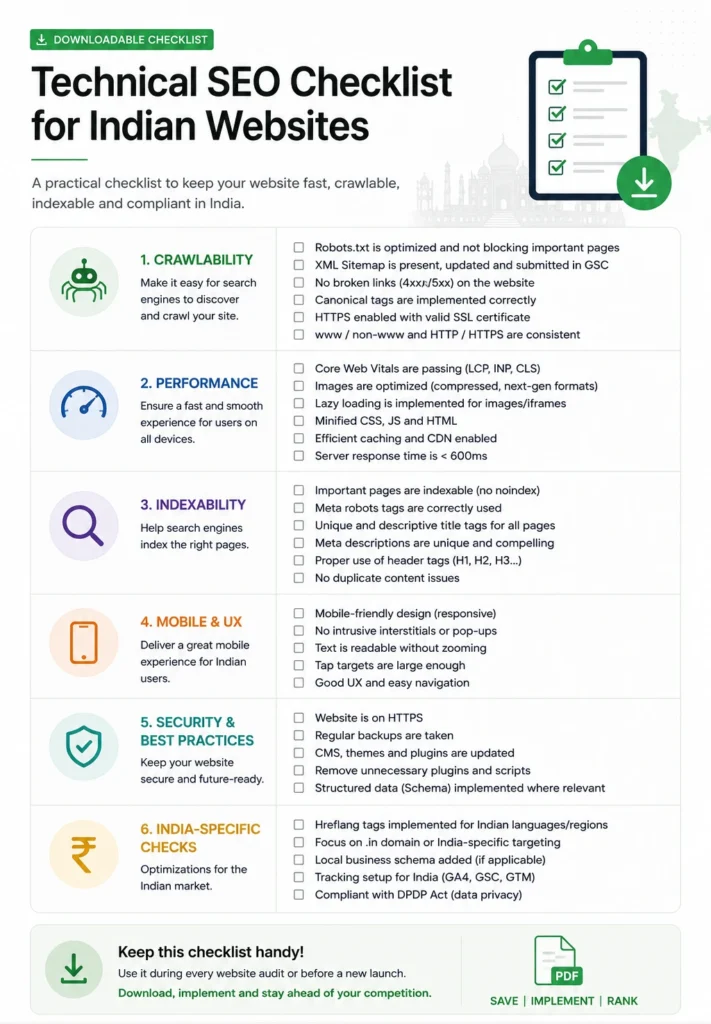
| # | Item | Category | Priority |
|---|---|---|---|
| 1 | robots.txt not blocking CSS/JS/sitemap | Crawlability | Critical |
| 2 | Canonical tags consistent across protocol/subdomain | Crawlability | Critical |
| 3 | LCP under 2.5s on a mid-range Android device, Indian network | Performance | Critical |
| 4 | INP under 200ms with third-party scripts deferred | Performance | Critical |
| 5 | CLS under 0.1, no layout-shifting cookie banners/ads | Performance | High |
| 6 | TTFB under 200ms from an Indian-hosted test | Performance | Critical |
| 7 | CDN with India-based edge nodes | Infrastructure | High |
| 8 | HTTPS everywhere, HSTS enabled | Security | Critical |
| 9 | DPDP-relevant data mapped and residency confirmed | Compliance | High |
| 10 | NAP consistent across site, schema, and Google Business Profile | Schema | Critical |
| 11 | FAQPage and LocalBusiness schema implemented and validated | Schema | High |
| 12 | hreflang reciprocal across all language versions | Multilingual | Critical |
| 13 | robots.txt reviewed for AI crawler policy (GPTBot, ClaudeBot, PerplexityBot) | AI Readiness | High |
| 14 | Mobile touch targets and font sizes tested on real low/mid Android devices | Mobile | High |
| 15 | No exposed .env/.git/config files | Security | Critical |

Conclusion
Most “technical SEO checklists” aimed at Indian businesses are templates with the rupee symbol swapped in. The actual risk for Indian websites in 2026 sits in a different place: mid-range device performance, India-aware hosting, DPDP Act data residency, multilingual hreflang, and AI crawler policy — none of which show up in a checklist written for a US or UK audience.
If you’d rather have a developer-led technical SEO audit run against your actual stack than work through this checklist line by line, that’s the kind of engagement Wistra9 runs for engineering teams across Bengaluru and Jaipur.
FAQs
Is technical SEO different for Indian websites compared to global standards?
The core mechanics (crawlability, Core Web Vitals, structured data) are the same worldwide. What’s different is the context: a mobile-majority, mid-range-device audience, multiple official languages, India-specific data protection law, and a much higher likelihood of shared hosting and plugin-heavy WordPress builds, all of which shift where the real performance and compliance risks sit.
What Core Web Vitals thresholds should Indian websites target in 2026?
The same official Google thresholds apply everywhere: LCP under 2.5 seconds, INP under 200 milliseconds, and CLS under 0.1, measured at the 75th percentile of real user visits. The difference in India is achieving them on the devices and networks your actual users have — test on a mid-range Android phone over 4G, not just a high-end device on office Wi-Fi.
Does the DPDP Act affect technical SEO and hosting decisions?
Yes, indirectly but materially. The DPDP Act and sector-specific rules (especially RBI’s payment data rules) influence where you can host certain categories of data, which third-party tools you can route customer data through, and how your consent/cookie setup is built — all of which intersect with site architecture and, in the case of consent banners, Core Web Vitals.
Should an Indian business block or allow AI crawlers like GPTBot and ClaudeBot?
For most businesses trying to grow visibility, allowing the search/citation-focused bots (OAI-SearchBot, ChatGPT-User, PerplexityBot, Claude-SearchBot) is the more common approach, since blocking them removes you from AI-generated answers entirely. Whether to allow the separate training-focused crawlers (GPTBot, ClaudeBot, Google-Extended) is a content-policy decision your business should make deliberately, not by default.
Does using a .in domain help SEO for an Indian business?
A .in ccTLD can be a mild geo-targeting signal and isn’t required for ranking in India. .com domains rank perfectly well with correct hreflang, Google Business Profile, and NAP signals. The bigger factor for India-specific visibility is consistent local signals and India-based hosting/CDN performance, not the TLD itself.
How often should a technical SEO audit be repeated?
A full audit every 6–12 months is reasonable for most sites, with Core Web Vitals and crawl errors monitored continuously via Search Console. Any CMS plugin update, hosting migration, or new third-party script (a new chat widget, a new payment gateway) is a trigger for an unscheduled spot-check, since these are the most common causes of regressions on Indian WordPress sites specifically.